
“Unfinished Business?”
And Karl Ove Knaussgård's book "Min Kamp"

Since retiring, I have had recurring dreams that follow a similar pattern. I find myself on a construction site, and I realize that the project is not finished, and that it will be a gargantuan task to complete it.
One recurring version of this is my crew and I are up on ladders struggling to paint one side of a very fancy Victorian house. But then I look around the other side of the house, and realize we haven‘t even started the other sides yet. I begin to panic. The project is in Big Trouble! I have a problem! I probably will never be able to finish it! My business will go under! I’ll go bankrupt!
In recent weeks, I have been listening to a podcast with one of my favorite pundits, a neuroscientist named Dr. Andrew Huberman, who interviews a Jungian therapist, Dr. James Hollis.
I think this podcast showed up on my “feed” because last month in my newsletter, I was talking about a Jungian psychologist that I took therapy from back in my college days when I went through a divorce.
The podcast is quite interesting, and I think worth the investment of time it takes to listen to it. I listened to it while working outdoors on my steam railway last week.
One of the things that Dr. Hollis says is that we spend about a third of our lives sleeping, and quite a bit of that time dreaming. He said, (and I am paraphrasing here)
“Nature doesn’t waste energy. There is a reason you have dreams (at night). Your subconscious is trying to tell you something (or some things.)”
He goes on to say that “there is a reason they call it your subconscious. It is the part of you that is hidden from your conscious mind. But in your dreams, it makes known what it wants you to be doing, or of problems you are ignoring, or repressing, while you are awake.”
He suggested writing down what your dreams are about and looking for patterns. He did not say that dreams are literally true or that any one dream is the key to your inner life, but he said again, “nature doesn’t waste energy, there is probably a pattern there you should be listening to…”
Reflecting on my recurring dream about “unfinished business,” I began to think, “I might be having a problem!”
This reminded me of a scene from the movie Groundhog Day, when Phil realizes that he has “a problem” - he is living the same day over and over again.
He wonders if he has “gone crazy” and tries to talk to his producer, Rita (played by Andie Macdowell), about it.
On the third day of his struggle, he pulls his producer aside during their morning TV segment, and says to her that he can’t do the broadcast, “I’m having a problem… I might be having a problem - I seem to be living the same day over and over again.” (at minute 5:50 of the clip above.)

She tells him they have to finish shooting and that she’ll meet him at the diner after they are done, and then they can talk about it.
When they meet and begin having breakfast, he tells her about his “problem” and that it was interfering with his being able to work - “I feel really weird. I seem to be living the same day over and over again.”
To which she replies, “You ought to get your head examined, if you expect me to believe a stupid story like that, Phil!” (at minute 9:30 of the YouTube clip above.)

GET YOUR HEAD EXAMINED…
Phil takes this advice literally!
The next scene is of him going to see a neurologist - he takes X-rays and puts them up on a screen for Phil to look at. The doctor tells him that nothing has shown up on his scans - there don’t seem to be any problems with his brain - but maybe he should see a psychiatrist?

He finds the local psychiatrist about his problem, which takes up most of their session together.

Their final exchange is with the psychiatrist saying, “OK, now I understand. How about we meet again tomorrow, and we can begin looking for some solutions?”
At this point Phil covers his face with a pillow and starts punching it! The psychiatrist then says, “I take it that tomorrow is not good for you??”
Min Kamp?… “My Struggle”
The Norwegian author, Karl Ove Knausgård, wrote a six-part (!) autobiographical novel titled “Min Kamp”1 in Norwegian, which is translated as “My Struggle” in the English version. I found it very interesting because he wrote about the things that happened in his life in a “semi-fictional” way - that is, he told the stories of real events with real people that happened years ago, but he “re-created” those scenes in fiction. I had never read an “autobiography” quite like it.2 The main thing he talked about was his struggle to become a writer, which is one reason I could identify with it.

The “struggle” he talks about in these books is the struggle of growing up and finding his own path in life - from his teens, into his twenties, and finally into marriage, children, adulthood, and career.
I mention this because it reminds me of a public radio program I listened to while riding around on my lawnmower several years ago. It was on the topic of transitioning to retirement, and it piqued my interest because I was just beginning my own retirement process.
The guest of the show mentioned that there are two periods of life that are particularly difficult for men3 - the first one is when they are in their twenties and have to move out from their parents’ home and make their own way in life, and the second is when they retire from their job or profession (and suicide rates continue to climb as they get older.) Men commit suicide at much higher levels at these two times of life, because they suffer from “failure to launch” and find their own path in life, or because after decades of “finding themselves in their work,” they no longer have a sense of meaning or purpose once their job or career has ended.4
Because James Hollis touched on this topic in the podcast I mentioned above, I decided to get a copy of his book that goes into more depth on these issues:
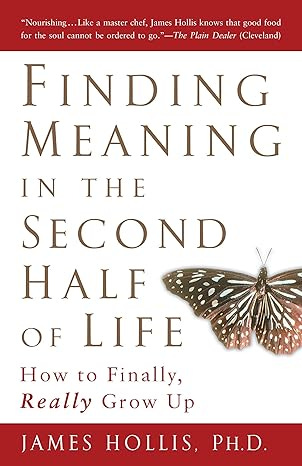
In this book, he mentions that people often look outside themselves for a source of meaning and satisfaction (or happiness). He describes these external things as “projections” because we “project” our happiness in life onto other people or things.
Speaking just for myself, I think some of my projections are:
“I will be happy when…”
I write a bestselling novel…
Becoming wealthy and admired by strangers!
My kids are successful - in work and marriage
We have grandkids and enjoy their company to our ripe old age!
I complete my steam railway in the yard…
To the amazement of my friends and neighbors!
I purchase a cottage in Sweden to fix up and recreate my childhood joy of living like a Swede in a village…
I learn to speak fluent Swedish and am commonly mistaken for a Swede!
My social media dabblings go viral…
This newsletter or my YouTube channel grow immensely popular - again resulting in wealth and fame for yours truly!
Hollis mentions some other common “projections” - meeting the perfect “soul mate” who will “complete you”, getting the dream job, achieving great financial success, and coming into a position of influence and power. All of these things, though not bad in themselves, will ultimately be hollow victories if we are not fulfilling our “soul’s mission” in the world.
“Aye, there’s the rub…”
Because he goes on to say that “finding happiness” is not the same as “fulfilling your soul’s mission in the world.” In fact, many of the people whom we admire for being unique individuals who fulfilled their inner calling might have struggled to become truly themselves. (This kind of goes back to Min Kamp!, which I mentioned above.)
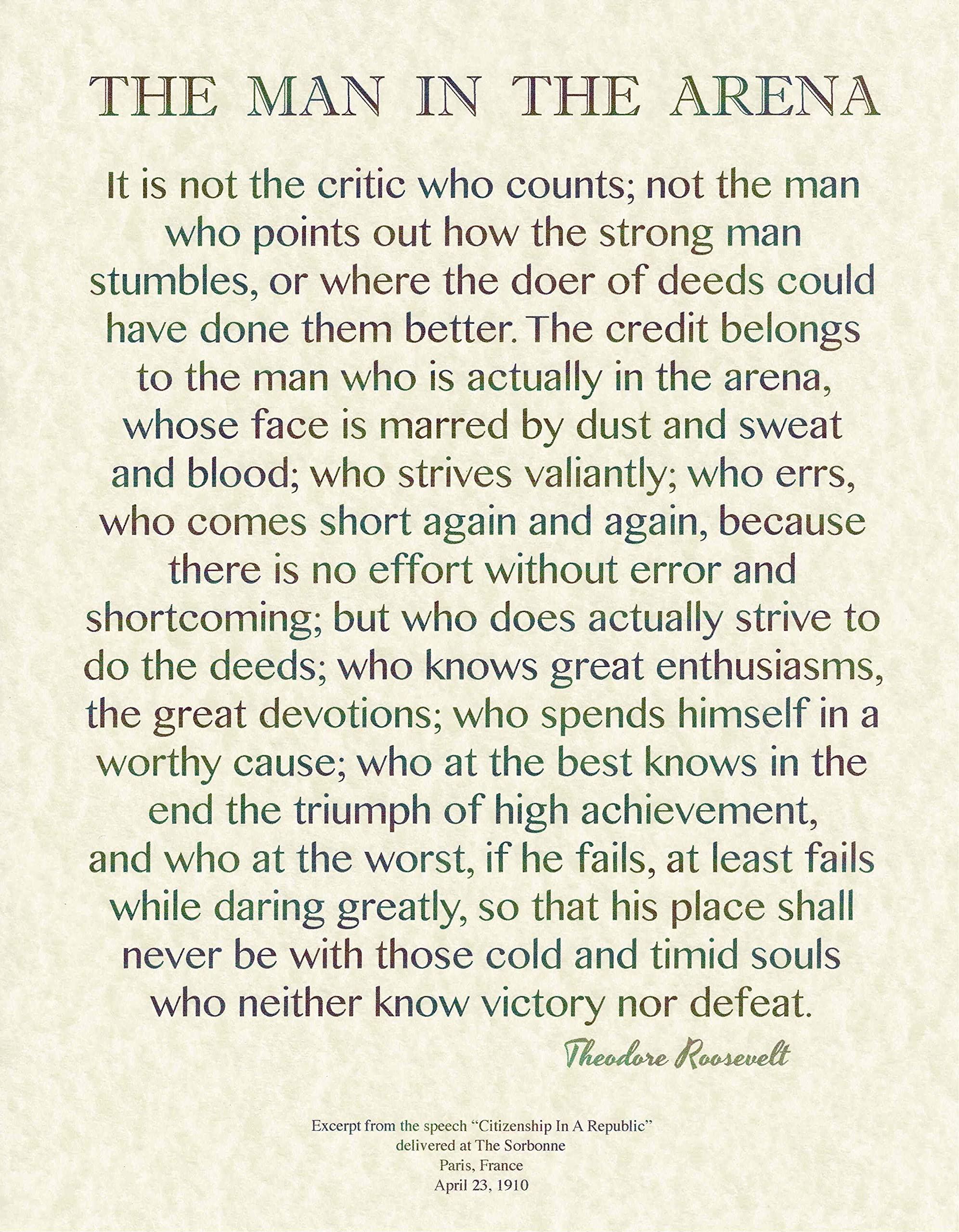
When my daughter Lauren was home for our Thanksgiving gathering last week, we somehow got on the topic of a plaque that used to hang over my desk. Because she used my computer for games or other work, she had to read it while things were downloading, etc. She laughed that she had inadvertently memorized the entire speech from Teddy Roosevelt, shown here:
To circle back to where I began, like "Phil” in the movie Groundhog Day, I seem to “have a problem” - and my nighttime dreams are pointing to some sort of “unfinished business” in my life. For that reason, I found the advice of James Hollis to be quite helpful in gaining some perspective on things I was projecting outward.
What I think this means is that I have not yet finished the work I was called to do here on earth - and there is more to do. This should not be a reason for despair, because I am apparently not all that different from any other retired man (or woman) - I still have things to do that could help me feel fulfilled at this stage of my life. And, possibly, continuing to engage in the struggle can be fulfilling just for its own sake.
Meanwhile, back at the Ranch…
Before the weather, rather suddenly, switched from fall to winter, I was working outside on my railway project. The goal was to make a railway siding and then a small shed to store my passenger car for the winter. I failed rather dramatically to achieve this goal!
For some reason, it reminded me of this song by Bruce Springsteen: the third verse summed up what happened.
When I look at myself, I don’t see
The man I wanted to be
Somewhere along the line, I slipped off track
I’m caught movin’ one step up and two steps back
“Somewhere along the line, I slipped off track, (One step up and Two steps back…)


Readers may recognize the title as roughly the same as Adolf Hitler’s book Mein Kampf, which he wrote while in prison for his part in attempting a coup.
There is an actual genre of memoirs in this vein, which I was unaware of. This style of fictionalized autobiography is termed “autofiction.” Apparently, it is pretty common in France, though much less so in the rest of Europe and America.
The host and guest were speaking specifically about men on this show, not to exclude women or their issues, which differ in some ways from the struggles of men. One reason is this statistic - that males commit suicide four times as often as women
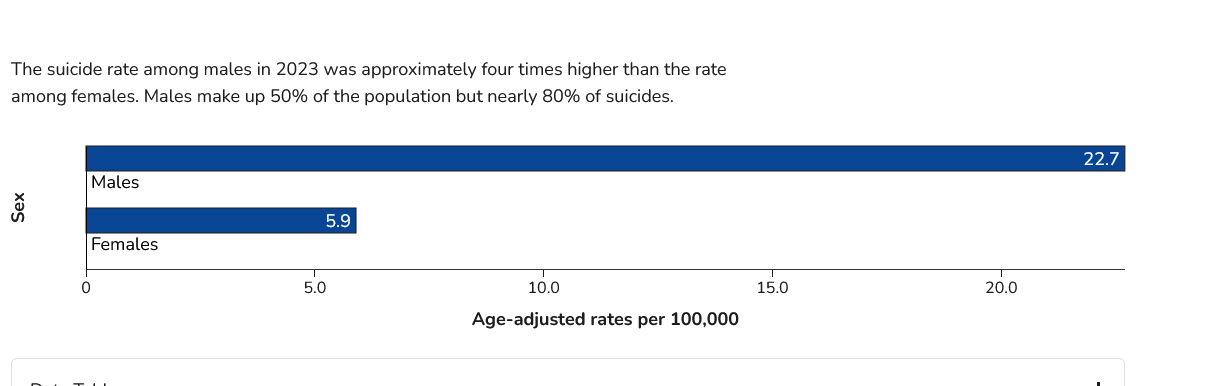
Another chart showing male suicide by age…

There’s quite a bit to unpack here, particularly regarding the James Hollis interview. I’d never watched, or even heard of, Andrew Huberman, which in itself is interesting, considering his 7.25 million subscribers. I appreciated the way he and his team organized the video. The well-detailed chapter markers made it easy to revisit several sections. Dr. Hollis offers plenty of thought-provoking ideas, and it took a couple of viewings to take it all in as I tried to keep up.
Far beyond the scope of a comment, the video would make for a great discussion over a cocktail… or two. I did come to one conclusion: I wouldn’t want Jungian psychoanalyst Dr. James Hollis inside my head, that would be a bit too intimidating. Nevertheless, it was an enjoyable and enlightening video.
I trust you’ve salvaged the railroad disaster before the weather truly hit. Here in Michigan, winter is at least a month, if not six weeks, early. I know you have plenty of outside projects; hopefully things are under cover. It appears we’re in for a long and bitter season.
Take care, stay warm.
—Mark